There is never a convenient time for a flat. Whether you are navigating the busy peak-hour crawl on the M4 or heading out for a weekend up the coast, discovering a nail in your tread is a universal frustration for Sydney drivers. However, knowing how to repair a punctured tyre is more than just a handy DIY skill: it is a vital safety competency that can save you from being stranded on a dangerous shoulder or shelling out for an expensive tow truck.
In this comprehensive guide, we will walk you through the mechanics of tyre damage, the tools you need, and a step-by-step process for a temporary roadside fix. More importantly, we will discuss the NSW roadworthy limits of DIY repairs and when it is time to leave it to a professional.
1. Safety First: The Golden Rules of Roadside Repairs
Before you even think about how to repair a punctured tyre, you must ensure your environment is safe. Australian roads, particularly high-speed motorways, can be incredibly hazardous for stationary vehicles.
Find Level Ground
Attempting to jack up a car on an incline is a recipe for disaster. The vehicle can shift, causing the jack to fail and potentially leading to catastrophic injury. If you feel a puncture, slow down gradually and look for a flat, firm surface, ideally a car park or a quiet side street.
Visibility is Key
If you are on the side of a road, turn on your hazard lights immediately. If you have a reflective safety vest in your glovebox, put it on. In NSW, it is recommended to place a warning triangle (if you have one) at least 20–30 metres behind your vehicle to give oncoming traffic plenty of notice.
The “No-Go” Zones
Never attempt a repair if:
- You are on a narrow shoulder with traffic passing dangerously close.
- The ground is soft or sandy (the jack will sink).
- You do not have a spare or a repair kit. In these cases, call for roadside assistance.
2. Anatomy of a Puncture: Can it Be Fixed?
Not every flat can be saved. Understanding the limitations of a repair is crucial for your long-term safety.
The “Repairable” Zone
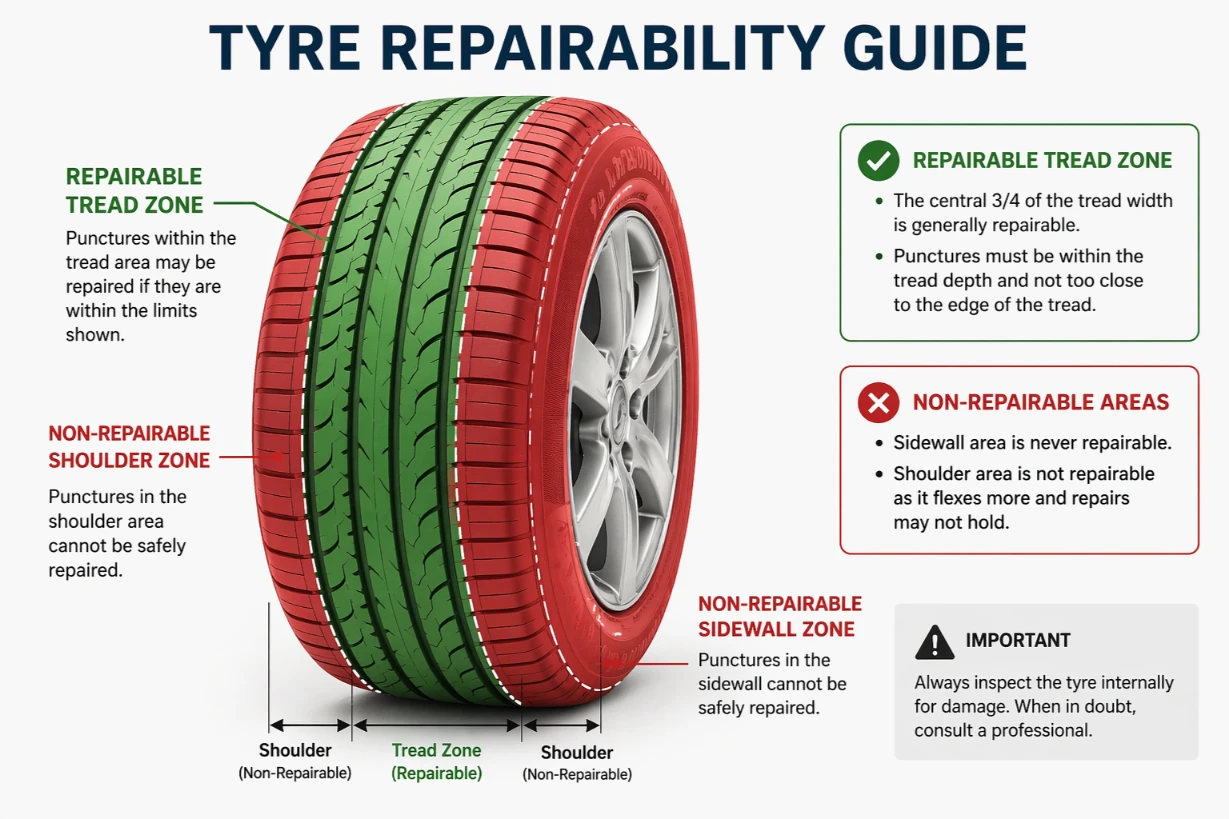
A tyre can generally be repaired if the puncture is located within the central 60–70% of the tread area (the part that touches the road). This is because the tread area is reinforced with steel belts that can hold a plug or patch securely.
The “Fatal” Zone (Sidewalls)
If the puncture is on the sidewall or the “shoulder” (where the tread meets the side), the tyre is officially a write-off. The sidewalls undergo immense flex every time the tyre rotates. A plug in the sidewall will eventually pop out, leading to a high-speed blowout.
Size Matters
If the hole is larger than 6mm (about the diameter of a pencil), a standard plug kit won’t suffice. Similarly, if the tyre has been driven on while flat, the internal structure may be shredded. Look for a ‘ring of wear’ or discolouration on the sidewall, as this is a clear sign the tyre is structurally compromised.
3. The Essential DIY Toolkit
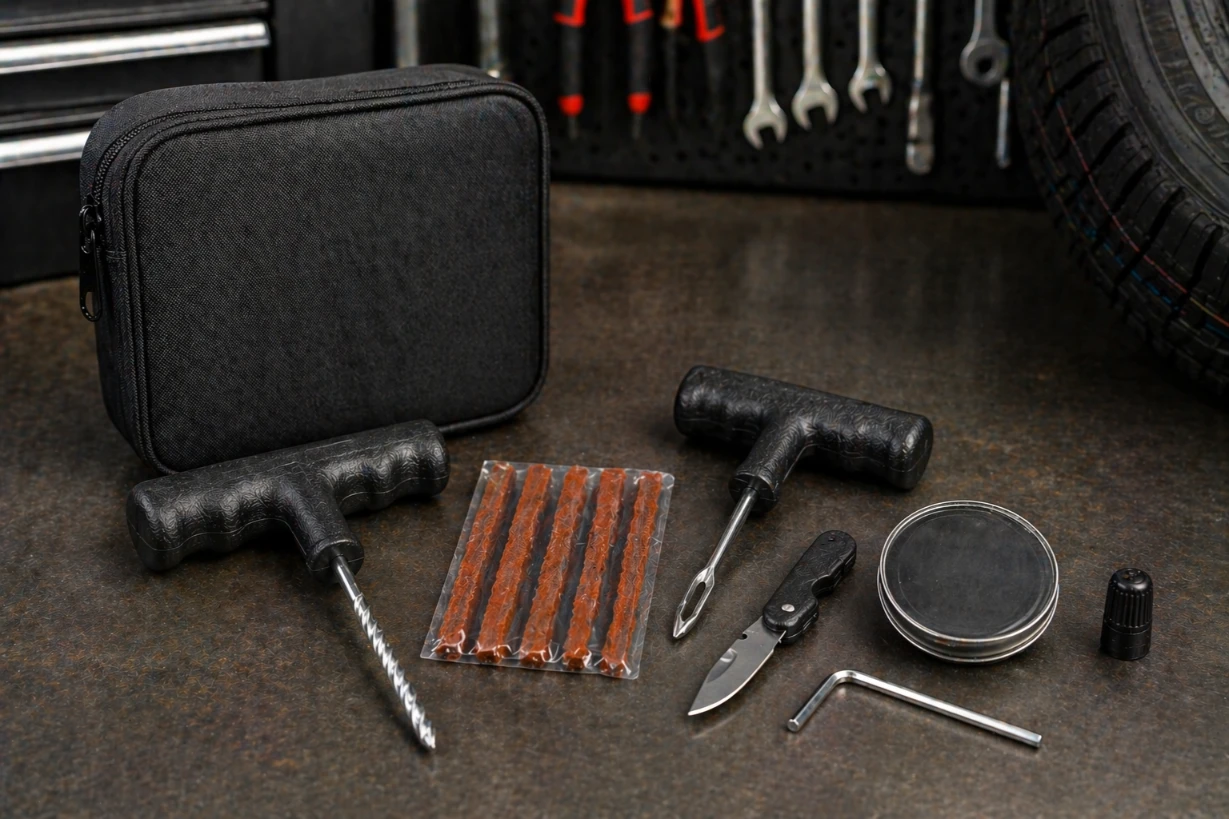
If you want to master how to repair a punctured tyre, you need the right gear. Most modern cars in Australia come with either a “space-saver” spare or a “gunk” canister (sealant kit). However, a dedicated plug kit is often a more reliable temporary fix.
- Pliers: To pull out the offending nail or screw.
- Reamer Tool: A T-handled tool with a raspy surface to clean and prep the hole.
- Plug Insertion Tool: To force the repair strip into the tyre.
- Repair Strips (Liquorice): Sticky, vulcanised rubber strips.
- Rubber Cement: To act as a lubricant and sealant.
- Portable Compressor: Because a repaired tyre is still a flat tyre until you put air back in it.
[Image: A layout of a standard tyre plug repair kit with labels]
4. Step-by-Step: How to Repair a Punctured Tyre
Follow these steps carefully. Remember, this DIY method (using a plug) is considered a temporary fix to get you to a service centre.
Step 1: Locate the Leak
If the nail is still in the tyre, it’s easy. If not, look for a hiss or bubbles. A common trick is to spray soapy water on the tread; the leaking air will create visible bubbles. Mark the spot with a piece of chalk or a crayon.
Step 2: Remove the Object
Using your pliers, pull the nail or screw out. Note the angle at which it entered, as you will need to follow this same angle with your tools.
Step 3: Ream the Hole
Insert the reamer tool into the puncture. Push it in and out several times while twisting. This cleans away any dirt and roughens the rubber so the plug can bond. This part requires some elbow grease!
Step 4: Prepare the Plug
Thread a rubber repair strip through the eye of the insertion tool (much like threading a needle). Apply a small amount of rubber cement to the strip to help it slide in.
Step 5: Insert and Trim
Force the insertion tool into the hole until about 1 to 2 cm of the strip is still visible on the outside. Pull the tool straight out quickly (the tool is designed to release the strip). Cut off the excess rubber so it is flush with the tread.
Step 6: Inflate and Test
Use your compressor to bring the tyre back to the recommended PSI (usually found on a sticker inside the driver’s door). Spray soapy water over the repair to ensure no bubbles are forming.
5. Beyond the DIY: Professional Plug-and-Patch Repair
While a DIY plug is great in an emergency, it is not a permanent solution under Australian Standards (AS 1973). A plug alone does not seal the inner liner of the tyre, which can allow moisture to reach the steel belts, causing them to rust and delaminate over time.
A professional repair at a workshop involves:
- Removing the tyre from the rim: To inspect for internal damage.
- A “Plug-Patch” (Mushroom Plug): A specialised piece of rubber that plugs the hole and patches the inside surface.
- Re-balancing: Whenever a tyre is repaired or moved, it must be re-balanced to prevent vibrations in the suspension and steering system.
6. Related Mechanical Considerations
A flat tyre often points to other issues or causes secondary problems that Sydney drivers should watch out for.
Wheel Alignment
If you find yourself getting frequent punctures on one side, or if your tyres are wearing unevenly, your wheel alignment may be out. Misaligned wheels can “drag” across the road, making the rubber thinner and more susceptible to debris.
Braking and Driveline Stress
Driving on a flat or a space-saver spare puts uneven stress on your clutch and driveline, especially on AWD or 4WD vehicles. Furthermore, your car’s ABS and stability control are calibrated for four identical tyres. If you are driving on a repaired tyre, avoid heavy braking and high speeds until you’ve had a professional safety check.
7. Preventing Future Punctures
While you can’t control what’s on the road, you can reduce your risk:
- Maintain Correct Pressure: An under-inflated tyre has a “softer” tread that is easier for nails to penetrate.
- Check Tread Depth: Worn tyres have less rubber to protect the inner carcass from sharp objects. If your tyres are getting low, it might be time for a rego inspection to see if they are still legal.
- Avoid the Gutter: Debris, glass, and nails naturally wash into the gutters and shoulders of Sydney roads. Stay in the main wheel tracks where the road is cleanest.
Frequently Asked Questions
